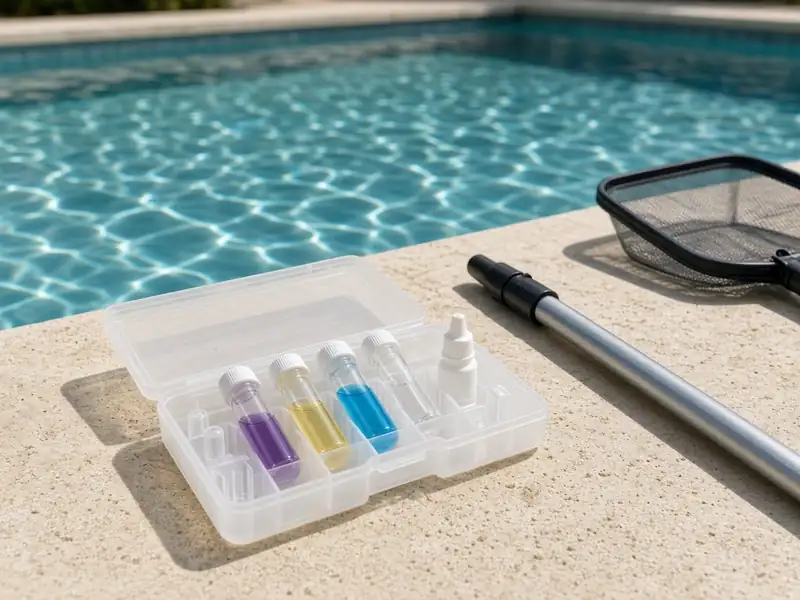
Miami pools don't get an off-season. The sun burns off chlorine fast, afternoon storms wash debris and rain into the water, and homes near the bay deal with salt air on top of it. This guide covers what a Miami weekly plan usually includes, what local companies publish about price, what to ask about salt systems and storms, and how to check a Florida license before anyone works on your equipment.
1. Cleaning doesn't need a license. Repairs do.
Florida law (section 489.105, Florida Statutes) says that using pool equipment for water treatment or cleaning "does not require licensure unless the usage involves construction, modification, or replacement of such equipment." So a maintenance-only company can legally clean your pool and balance the water. Replacing a pump, heater, filter system or salt system, plumbing work, and resurfacing are contractor work, and that needs one of these:
- CPC, a Certified Pool/Spa Contractor, valid statewide.
- RP, a Registered Pool/Spa Contractor, valid in the local jurisdictions where it's registered.
Of the 9 Miami companies in our directory, 5 hold a CPC license that we found active on DBPR. The other 4 are maintenance-only, so we list them for cleaning and water care, not repairs.
2. What Miami companies actually charge
Most Miami companies quote after seeing the pool. Two publish numbers. Here's what their websites said on November 3, 2026:
- Alligator Pools lists weekly service for a standard 15×30 pool in average condition. Its Limited plan starts at $90/month (shown marked down from $99). It covers water chemistry, skimmer and pump baskets, equipment monitoring and filter cleaning as needed, and the company says it's best for screened pools or owners who do some of the work. Full Service starts at $145/month (marked down from $165) and adds surface skimming, brushing walls and tile, and vacuuming as needed. Final pricing follows an in-person inspection. A start-up fee may apply if the water needs extensive treatment, but it says this typically doesn't apply if you're switching from another active service. Its repair diagnosis visit is $125, and you pay nothing if it can't find the problem.
- FloPool publishes a 2026 Miami price guide on its blog: $150–$175/month for weekly service on a standard pool up to about 15,000 gallons, chemicals included, and $175–$250/month for an oversized pool or one with an attached spa. Its one-time prices are $150–$300 for a post-storm debris cleanout, $350–$700 for green-to-clean recovery (2 to 4 visits), $150–$175 for a cartridge filter deep clean and $150–$250 for a DE filter breakdown.
Other companies explain how they price without giving a number. JAF Pool & Patio sets one fixed monthly price for a standard 10,000–20,000 gallon in-ground pool after a free inspection. Blue Operator Pool Service quotes from photos you send and measures the pool from satellite maps.
Treat these as reference points, not a market average. Pool size, screening, trees overhead, a spa, and the age of the equipment all move the price. Get your own written quote.
3. Know what's included and what's extra
The monthly price is only comparable if the scope is. Here's how three Miami companies draw the line, from their own sites:
- Blue Operator includes standard chemicals (chlorine, acid, stabilizer) and a monthly filter cleaning. Specialty chemicals such as phosphate removers, enzymes and clarifiers, salt cell cleanings, major storm cleanups, and repairs cost extra, and it says you get an estimate first.
- JAF Pool & Patio includes weekly chemical service, brushing, skimming, vacuuming and an equipment check. Equipment repairs, salt cell replacement, acid wash or tile cleaning, and green pool restoration are quoted separately, with your approval first.
- Alligator Pools separates its cheaper chemistry-and-baskets plan from full service that includes brushing and vacuuming, as above.
4. Salt pools and salt air
Salt systems are common in Miami, and they need their own care. A salt pool is still a chlorine pool: FloPool explains that the cell turns salt (kept at about 3,000–3,500 ppm) into chlorine on site. It also warns that salt is corrosive to handrails and ladder anchors, screen-enclosure fasteners, light rings and natural stone coping such as travertine, and that homes near the water in places like Key Biscayne and Miami Beach already face salty air. Its advice is to rinse the deck and hardware with fresh water regularly. JAF Pool & Patio says salt cells in South Florida homes last 3–5 years, compared with 5–7 years inland. If you have a salt pool, ask:
- Do they check salt level and the cell on every visit, not just chlorine? Blue Operator, Pool Wizards and Vita Pura Pool Services all describe salt-system checks or service on their sites.
- Is cell cleaning included? At Blue Operator and JAF it isn't part of the base price. Pool Wizards offers salt cell acid washing as a service.
- Who replaces a failed cell? That's equipment replacement, so it should be a licensed contractor.
5. Year-round heat and summer storms
FloPool's residential page notes that Miami's UV burns off chlorine faster, heavy summer rain dilutes the water, and warm water lets algae grow year-round. JAF says a pool that misses a week in June "isn't dirty — it's a chemistry mess." So:
- Weekly beats every other week here. Gables Pool offers both weekly and bi-weekly maintenance. If you pick bi-weekly to save money, compare the savings with the cost of a green-pool recovery.
- Ask about stabilizer (cyanuric acid). It protects chlorine from the sun, but too much locks it up. JAF says it tests cyanuric acid frequently. Ask how often yours will be tested.
- Get the storm policy in writing. Atlantic hurricane season runs through November 30. Blue Operator bills major storm cleanups separately and gives priority to its higher-tier plan, and FloPool lists post-storm cleanouts at $150–$300. Ask what's included, who gets served first, and who inspects the pump, heater and electrical before the system restarts.
6. Questions to ask any Miami company
- Are chemicals included? Which ones, and what costs extra?
- Is there a contract? Alligator Pools, Blue Operator, FloPool and JAF all say there's no long-term contract. Ask about the cancellation notice.
- Same tech every week? FloPool and JAF both promise the same tech or crew on the same day.
- Will you get a report after each visit? Blue Operator sends a photo report, and FloPool texts chemical readings after every visit.
- How often is the filter cleaned, and is it included?
- Who does repairs, and under what license number? Then look it up (below).
- Do they carry liability insurance? Ask for a certificate of insurance.
7. How to check a Florida pool license (about 2 minutes)
- Go to the DBPR license search at myfloridalicense.com.
- Search by license number (for example,
CPC1234567) or by name. Try the business name and the owner's name, since licenses are held by a person and often listed under a DBA. - Check that the status is Current, Active and that the expiration date is in the future.
- Make sure the name on your contract matches the license holder or its DBA.
8. Compare like for like
Get two or three written quotes with the same scope: visit frequency, chemicals included or not, filter cleaning, salt cell care, the storm-cleanup policy, and the repair license number. Our Miami pool service directory lists each company's license status as we found it on DBPR, with the date we checked. You can also send one request describing your pool.
Sources: section 489.105, Florida Statutes (flsenate.gov); Florida DBPR license records (myfloridalicense.com), checked October 31, 2026; alligatorpools.com/pricing/; flopool.com (residential service page, FAQ, and blog posts "How much does pool maintenance cost in Miami" and "Salt water pool vs chlorine in South Florida"); blueoperatorpool.com (services and FAQ pages); jafpoolandpatio.com/services/weekly-pool-cleaning; poolwizards.com (residential weekly service and salt system pages); gablespool.com/maintenancecleanup-services; vitapurapoolservices.com/services. Company pages checked November 3, 2026. Prices change, so confirm with the company. This is general information, not legal advice.
Ready to compare?
Browse verified Miami pool companies, with license status and the date we checked.